
If you’ve been trying to figure out marketing funnels for small business, you’ve probably come across advice that sounds like this: build a webinar funnel, a tripwire funnel, a high-ticket funnel, a VSL funnel, a self-liquidating offer funnel…
Stop.
Most of that advice is built for marketers with teams, budgets, and time to burn. As a small business, you don’t need any of it. In fact, trying to build six funnels before you’ve nailed one is one of the fastest ways to burn out and get nowhere.
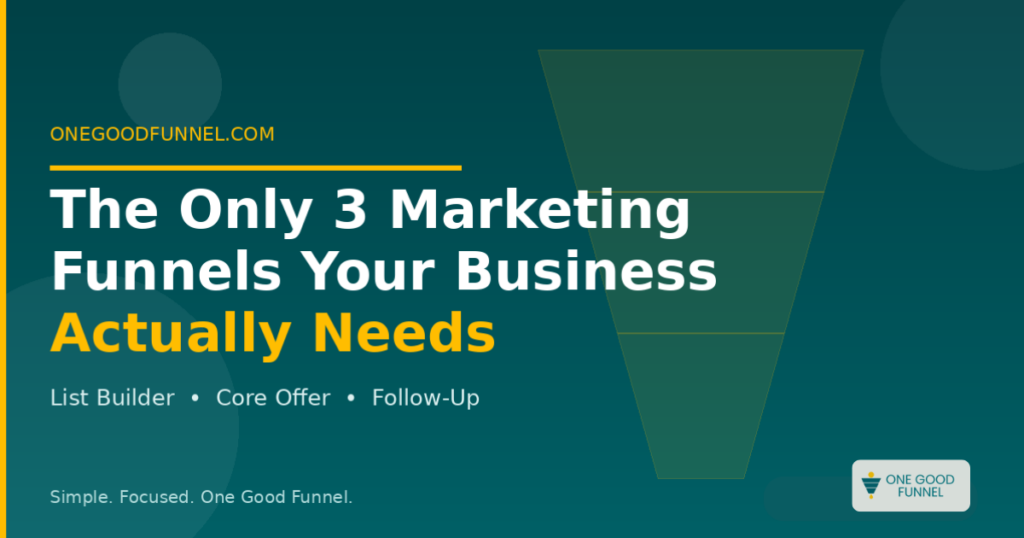
Here’s the truth: every small business that makes consistent money is running some version of the same three marketing funnels. Not six. Not ten. Three.
Here’s what they are — and why each one matters.
The 3 Marketing Funnels Every Small Business Needs
Funnel 1: A List Builder
(A way to turn strangers into contacts)
This is where every small business marketing funnel starts.
A list builder is any system that gives someone a reason to hand over their contact information — usually their email address — in exchange for something valuable. A free guide. A checklist. A discount code. A short video. Whatever makes sense for your business.
Why it matters: For any marketing funnel for small business to work, you need a way to follow up with people after they find you. Right now, someone is finding your content, thinking “that’s interesting,” and then scrolling on. Gone forever. You have no way to follow up, no way to stay in touch, no way to make an offer when the timing is right. A list builder plugs that leak.
Real example: A fitness coach posts a free “7-Day Meal Plan” on their website. Visitors enter their email to download it. Now the coach has a contact — someone who raised their hand and said “yes, I’m interested in what you do.” That’s the beginning of a relationship, and the beginning of a working marketing funnel.
What happens if you skip it: You’re completely dependent on people happening to find you again at exactly the right moment. That’s not a marketing system. That’s hope.
You don’t need a complicated opt-in strategy. You need one clear free offer and one simple page where people can sign up to get it.
Funnel 2: A Core Offer Funnel
(A way to make the first sale)
Once someone is on your list, the next job is simple: give them a clear path to buy.
A core offer funnel is the small business marketing funnel around your main thing. The product, service, or program that pays the bills. One clear offer, one clear outcome, and one clear path to get there.
Why it matters: The most overlooked part of marketing funnels for small business is having a clear path to purchase. Most small businesses have an offer but no funnel around it. Someone lands on their website, sees a general “Work with me” page, and has no idea what happens next, what they’ll get, what it costs, or how to start. Confused people don’t buy.
Real example: A web designer offers a “Starter Website Package” — five pages, delivered in two weeks, for a flat fee. Their funnel is simple: someone books a free 20-minute discovery call, gets a follow-up email with the offer and a payment link, and either says yes or no. That’s a core offer funnel.
What happens if you skip it: You have revenue, but it’s random. Some months are great. Some are dead. You’re not sure why either way because there’s no system — just individual sales that happen when the stars align.
One clear offer. One clear outcome. One clear next step.
One good funnel, done well, changes everything.
Ready to build your first one? Read [How to Build Your First Simple Marketing Funnel] to get started this week. No tech headaches, no overwhelm, just a clear path forward.
Funnel 3: A Follow-Up Funnel
(A way to make the next sale)
This is the marketing funnel most small businesses skip — and it’s the one that makes the biggest difference to consistent revenue.
A follow-up funnel is what happens after someone joins your list or makes their first purchase. It’s the emails, the sequences, the check-ins, the new offers, the repeat promotions. It’s the system that keeps the relationship going so you’re not starting from zero every single month.
Why it matters: The hardest sale is the first one. Once someone has bought from you and had a good experience, they’re far more likely to buy again — but only if you stay in front of them. Most small businesses make a sale and then go completely silent until they need money again. That’s not a relationship. That’s a transaction.
Real example: A photographer sells a family portrait session. After the shoot, they send a thank-you email. A week later, tips on how to display photos at home. A month later, a holiday mini-session offer. Three emails. One simple follow-up funnel. That’s it.
What happens if you skip it: You work incredibly hard to find new customers every single month instead of keeping the ones you already have. Revenue stays unpredictable. Growth stays slow.
You don’t need a 30-email automation sequence. You need a handful of well-timed messages that remind people you exist and give them a reason to buy again.
The Simplest Way to Think About Marketing Funnels for Small Business
Strip it all the way down and here’s what you have:
- A way to capture attention — turn strangers into contacts
- A way to make the first sale — turn contacts into customers
- A way to make the next sale — turn customers into repeat buyers
That’s the whole game.
Every complicated marketing funnel strategy you’ve ever seen is just a variation of these three things. The difference between small businesses that grow consistently and those that feel like they’re always starting over comes down to which of these three they’ve actually built.
You don’t need to build all three at once. Start with the one that’s most missing from your business right now. Get it working. Then build the next one.
One good funnel, done well, changes everything.
Frequently Asked Questions
Do small businesses really only need 3 marketing funnels? Yes — at least to start. Most small businesses that struggle with marketing aren’t failing because they have too few funnels. They’re failing because they never finished building one. Master these three first, then add complexity only if your business genuinely needs it.
Which of these 3 marketing funnels should I build first? Start with whichever one is most obviously missing. If you have no way to collect email addresses, start with a list builder. If you have an audience but no clear offer, build your core offer funnel. If you’re making sales but revenue is unpredictable, build your follow-up funnel.
How long does it take to build a marketing funnel for a small business? A simple version of any one of these three funnels can be set up in a week. It doesn’t need to be perfect — it needs to work. You improve it over time.
What tools do I need to build marketing funnels for small business? Far fewer than you think. A simple email tool, a basic landing page, and a payment link cover most of what you need to get started.
Ready to build your first one? Read [How to Build Your First Simple Marketing Funnel] to get started this week — no tech headaches, no overwhelm, just a clear path forward.