If you’re still trying to make big marketing funnels work for your small business, you’re not alone. But there’s an easier way—micro funnels.
In this post, I’ll walk you through how to set up a simple micro funnel you can launch this week, the different types of micro funnels you can use, and how to avoid common mistakes. If you’ve got 30 minutes, you can get one live.
First, What Is a Micro Funnel?
A micro funnel is a short, focused sequence designed to move someone from awareness to action in as few steps as possible. It’s simple, fast, and works with the tools you already use.
Most micro funnels follow this format:
-
One point of entry (like a social post, message, or email)
-
One clear next step
-
One goal—get the sale, book the call, or start the conversation
The 3 Main Types of Micro Funnels
Before we dive into the tutorial, let’s clear up one thing—there are different types of micro funnels. Here’s a quick breakdown:
1. Social Media Micro Funnel
Starts with a post, moves to DMs, then to a sale or booking.
Perfect for coaches, creators, and service providers.
2. Email Micro Funnel
Starts with a freebie or opt-in, then delivers a short email sequence.
Great for launching offers or reactivating past leads.
3. Product Micro Funnel
Focuses on one product with a quick-buy page and a follow-up offer.
Works well for e-commerce and digital products.
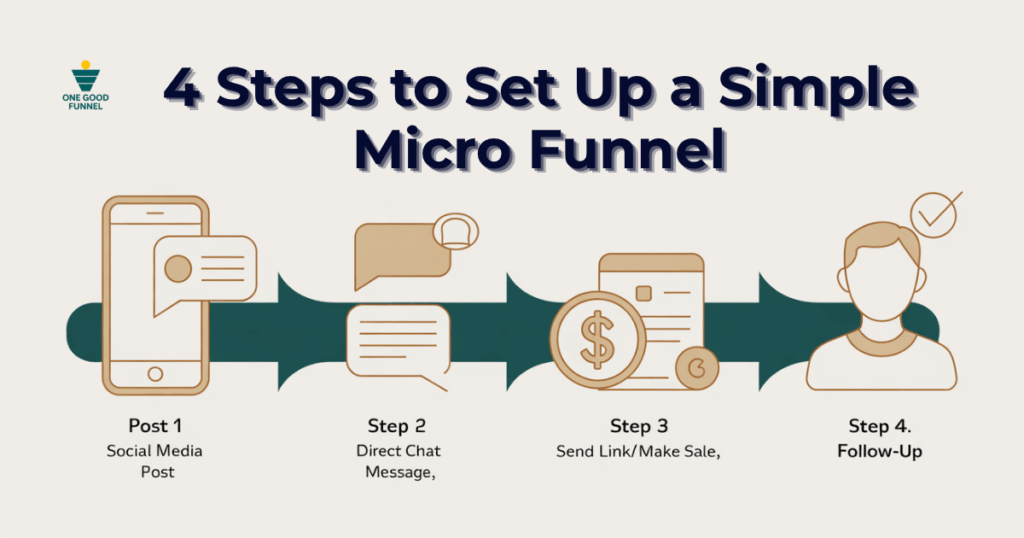
👉 In this blog, we’re walking through how to set up a simple micro funnel using the social media format; the fastest one to launch.
One Simple Micro Funnel You Can Set Up This Week
Here’s how to get a micro funnel up and running by the weekend.
Step 1: Post on Social
Create a post that highlights one product, service, or offer.
-
Make it clear and specific
-
Add a call to action: “DM me for the link” or “Want the discount? Message me”
-
Keep it friendly and easy to respond to
Example:
New fall menu is live. 🍂 Our pumpkin chai is selling out fast. Want early access and a free topping? DM me now!
Step 2: Start the Conversation
When someone messages you, reply quickly and personally.
-
Answer their questions
-
Offer the link or next step
-
Make it feel like a real conversation, not a script
Pro tip: Save a few message templates in Notes to reply faster without sounding robotic.
Step 3: Send the Link and Close the Sale
Once they’re ready, send the payment link, booking page, or order form.
-
Use PayPal, Stripe, Square—whatever works
-
Make the process as easy as possible
-
Thank them after they buy
Step 4: Follow Up
This is where most people drop the ball.
-
Check back if they ghosted you
-
Ask how they liked the product
-
Invite them to share with a friend or leave a review
Common Pitfalls to Avoid
Micro funnels are simple. Don’t complicate them.
Mistake #1: Trying to Automate Too Soon
You don’t need fancy tools to start. Focus on real connection.
Mistake #2: Copying Big Brands
What works for Amazon won’t work for you. Your personal touch is your advantage.
Mistake #3: Forgetting to Follow Up
Most sales don’t happen on the first try. Follow up like a human.
Mistake #4: Doing Too Much
Pick one offer. One funnel. One platform. Make it work before adding more.
Your Next Step
Micro funnels work when you actually use them. So let’s go.
-
Choose your offer
-
Write a post
-
Talk to people
-
Share the link
-
Repeat
That’s it.
If you’ve been waiting to learn how to set up a simple micro funnel without tech headaches—now’s the time.
Next up: I’ll break down other types of micro funnels you can use depending on your business model. This is just the beginning.
